

Light-pollution filters can improve contrast by reducing portions of artificial sky glow, making some deep-sky objects easier to observe from suburban and urban locations. Broadband filters are more versatile for stars and galaxies, while narrower UHC and OIII filters are generally more effective for emission nebulae.
This guide covers the best light-pollution filters for telescopes, focusing on filter type, bandwidth, light-rejection performance, optical quality, telescope aperture compatibility, thread size, deep-sky performance, and overall value.
1. Svbony Telescope Filter

The SVBONY Telescope Filter, 1.25″ UHC Filter is ideal for amateur astronomers and astrophotography enthusiasts looking to enhance their stargazing experience. If you want to improve the clarity and contrast of celestial objects, especially nebulae, while reducing the effects of light pollution, this filter is designed specifically for you.
Pros:
- Improves contrast and visibility of nebulae and other deep-sky objects
- Made with high-quality optical glass lens for clear and sharp images
- Durable aluminum frame ensures long-lasting use
- Effectively reduces light pollution for better astrophotography results
- Compatible with most telescopes using a 1.25-inch filter holder
Cons:
- May slightly reduce overall brightness due to filtering
- Not suitable for wide-field views or planetary observation
The SVBONY 1.25″ UHC Filter is crafted from premium optical glass that enhances the contrast of faint celestial objects by selectively filtering out unwanted wavelengths of light. This feature is especially beneficial when observing nebulae, as it allows the intricate details and structures to become more visible against the dark sky background. The sturdy aluminum frame provides durability and ease of attachment to your telescope, ensuring a secure fit during observation sessions.
In addition to its optical advantages, this filter effectively combats the problem of light pollution which plagues many urban and suburban astronomers. By blocking specific wavelengths emitted by streetlights and other artificial sources, the SVBONY filter enhances the quality of astrophotography and visual observation alike. This makes it a valuable accessory for those aiming to capture clearer, more detailed images of the night sky without investing in expensive equipment.
To buy this product, click here.
2. Svbony Telescope Filters Cls 1.25″ Light Pollution Broadband Filter

The SVBONY Telescope Filters, CLS 1.25″ are ideal for amateur astronomers and astrophotographers who want to enhance their deep sky observations and photography. If you are someone who struggles with light pollution from city lights or wants to capture clearer images of nebulae and other celestial objects, this filter is designed for you. It is perfect for users seeking to improve visibility and image quality during night sky viewing and long-exposure photography.
Pros:
- Reduces light pollution effectively to enhance night sky clarity
- 90% transmission of nebula emission lines for brighter and clearer images
- Compatible with 1.25″ telescope eyepieces making it versatile and easy to use
- Improves contrast and detail in deep sky visual astronomical photography
- Manufactured by the reputable SVBONY brand known for quality optical accessories
Cons:
- May slightly reduce brightness of some star fields due to filtering
- Best results require a telescope with good focal ratio and quality optics
The SVBONY CLS Light Pollution Broadband Filter is engineered to selectively transmit nebula emission lines while blocking out unwanted artificial light sources. This means users can enjoy sharper and more contrasted views of deep sky objects even in urban or suburban environments. Its 90% transmission rate ensures minimal loss of light from celestial sources, making it a great tool for both visual observation and photographic capture.
The filter’s 1.25″ size allows it to fit most standard telescopes and eyepieces easily, making it highly adaptable for various astronomical setups. By reducing the interference caused by streetlights and other light pollution, users can capture more detailed images of nebulae and other faint celestial bodies. Overall, this filter enhances the viewing experience and photographic results for astronomy enthusiasts seeking to overcome the challenges of light-polluted skies.
To buy this product, click here.
3. 1.25 Inch Uhc Filter For Telescopes

The 1.25 Inch UHC Filter for Telescopes is ideal for amateur astronomers and astrophotographers seeking to enhance their viewing experience by reducing light pollution and increasing contrast. If you often observe nebulae, the moon, or other deep-sky objects in urban or suburban areas, this filter is designed to deliver clearer and more detailed images. Its compatibility with standard 1.25-inch telescope eyepieces and M28.5×0.6 threads makes it a versatile addition to your astronomy gear.
Pros:
- Effectively reduces light pollution for clearer night sky views.
- Ultra High Contrast (UHC) technology enhances nebula and moon details.
- Compatible with standard 1.25-inch telescope eyepieces and M28.5×0.6 threads.
- Manufactured by FIBONAX, a trusted brand in astronomy accessories.
- Improves overall visibility of faint celestial objects.
Cons:
- May slightly reduce brightness of stars due to filtering effect.
- Best performance noticed primarily in areas with moderate to high light pollution.
This UHC filter is engineered to selectively block out unwanted wavelengths of artificial light, such as sodium and mercury vapor emissions, which are common in urban environments. By filtering these wavelengths, it increases the contrast between celestial objects and the background sky, making nebulae and lunar features more prominent and easier to observe. The 1.25-inch size ensures that it fits most common telescope eyepieces, while the M28.5×0.6 threading guarantees a secure and easy attachment.
The filter’s design allows amateur astronomers to enjoy a more immersive and detailed viewing experience without the need for expensive equipment upgrades. Whether you are observing the intricate structures of emission nebulae or the surface details of the moon, the FIBONAX UHC filter significantly enhances clarity and contrast. Its durable construction ensures long-lasting performance, making it a valuable accessory for both casual stargazers and serious astrophotographers.
To buy this product, click here.
4. Celestron Uhc/lpr Light Pollution Reduction Filter For Telescopes – 1.25″

The Celestron UHC/LPR Light Pollution Reduction Filter is ideal for amateur astronomers and stargazing enthusiasts who want to enhance their visual experience through a telescope. If you often observe from urban or suburban areas with considerable light pollution, this filter is designed to improve your view by reducing unwanted artificial light and increasing the contrast of celestial objects like nebulae. It is perfect for those seeking clearer and sharper night sky observations without the need for expensive equipment upgrades.
Pros:
- Effectively reduces light pollution for a darker sky background
- Enhances the contrast of nebulae and other deep-sky objects
- High transmission optical coating ensures bright and clear images
- Easy to install with a standard 1.25″ size compatible with most telescopes
- Manufactured by trusted brand Celestron
Cons:
- Designed primarily for visual use, not suitable for astrophotography
- May slightly reduce overall brightness of some objects
- Limited effectiveness in extremely heavy light pollution conditions
The Celestron UHC/LPR Filter employs specialized coatings that selectively block common wavelengths emitted by streetlights and other artificial sources, while allowing the wavelengths from nebulae and other celestial bodies to pass through. This results in a significantly improved contrast and a more darker sky background, making faint objects stand out more clearly to the eye. Its high-quality optical coating ensures that the light transmission remains high, preserving the brightness of the objects observed.
Designed for visual use, this filter is simple to attach to any telescope with a 1.25″ eyepiece holder. Users will immediately notice enhanced views of emission nebulae, supernova remnants, and other deep-sky targets, even from areas affected by moderate light pollution. While it may slightly reduce the overall brightness, the trade-off is a more detailed and immersive stargazing experience that can greatly enrich amateur astronomy sessions.
To buy this product, click here.
5. Svbony Sv240 Telescope Filter

The SVBONY SV240 Telescope Filter is ideal for amateur astronomers and astrophotography enthusiasts who want to enhance their visual observations and city astrophotography. This filter is perfect for users seeking to increase contrast and detail when viewing celestial objects, especially in light-polluted environments. If you are looking to improve the clarity of nebulae and other deep-sky objects, this multi-narrowband filter is a great addition to your telescope accessories.
Pros:
- Enhances contrast by isolating specific wavelengths (Ha, OIII, H-Beta)
- 1.25 inch size fits most standard telescopes
- Improves visibility of faint celestial objects in urban areas
- High-quality construction from trusted brand SVBONY
- Suitable for both visual observation and astrophotography
Cons:
- May reduce overall brightness when used on brighter objects
- Limited to specific wavelengths, not ideal for broad-spectrum viewing
The SVBONY SV240 Multi-Narrowband Filter is designed to selectively transmit important emission lines such as Hydrogen-alpha (Ha), Oxygen-III (OIII), and H-Beta, which are crucial for revealing fine details in nebulae and other deep-sky targets. By filtering out unwanted light pollution and other interfering wavelengths, it significantly increases the contrast and sharpness of the images you observe or capture. This makes it an essential tool for astronomers living in cities or areas with heavy light pollution.
Crafted with precision by SVBONY, the filter fits snugly into the 1.25-inch eyepiece holder of most telescopes, making it a versatile accessory for various telescope models. The ability to use it for both visual observation and astrophotography adds to its value, allowing users to enjoy enhanced views through the eyepiece while also capturing stunning images with improved detail and reduced background noise. Overall, the SV240 filter is a practical choice for those aiming to elevate their stargazing experience under challenging light conditions.
To buy this product, click here.
6. Svbony Sv220 Telescope Filter
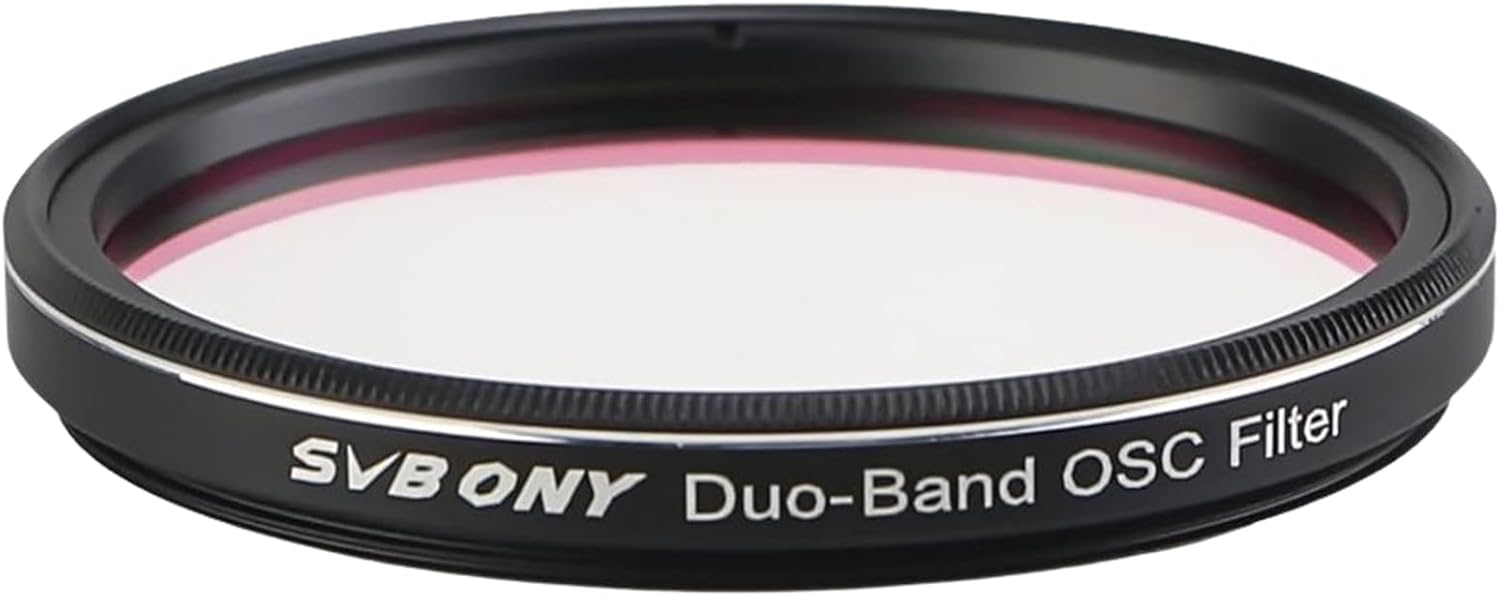
The SVBONY SV220 Telescope Filter is ideal for amateur and professional astrophotographers who want to enhance their deep sky imaging. If you own a one-shot color camera or a telescope and seek to capture clearer, more detailed images of nebulae by reducing unwanted light pollution, this 2″ 7nm dual-band nebula filter is designed specifically for you.
Pros:
- Effectively blocks stray light to improve image contrast and clarity.
- Dual-band design targets both H-Alpha and O-III wavelengths for enhanced nebula visibility.
- Compatible with various telescopes and one-shot color cameras.
- High-quality manufacturing by the trusted SVBONY brand.
- Easy to install 2″ size fits standard telescope eyepiece holders.
Cons:
- May not be suitable for wide-field astrophotography due to narrowband specifications.
- Filter effectiveness depends on camera and telescope setup.
The SVBONY SV220 Telescope Filter features a precise 7nm bandwidth that isolates the critical emission lines of H-Alpha and O-III, which are essential for capturing the vibrant details of emission nebulae. This dual-band capability allows users to reduce the effects of light pollution and atmospheric interference, resulting in sharper and more vivid images during deep sky observation. Its compatibility with one-shot color cameras means astrophotographers can capture detailed nebular structures without needing multiple exposures or filters.
Constructed by SVBONY, a respected name in telescope accessories, this filter boasts reliable quality and durability. The 2″ size ensures it fits most telescopes easily, allowing for quick installation and removal. By effectively blocking unwanted light while enhancing specific nebular wavelengths, the SV220 filter elevates your astrophotography experience, making it a valuable tool for anyone looking to improve the quality of their deep sky imaging.
To buy this product, click here.
7. Svbony Sv115 Telescope Filter O-iii Filter

The SVBONY SV115 Telescope Filter O-III Filter 2 inch, 18nm Narrowband is ideal for amateur astronomers and astrophotographers looking to enhance their night sky observations. This filter is designed for those who want to increase the contrast of celestial objects without increasing brightness, making it perfect for users facing light pollution challenges in urban or suburban areas.
Pros:
- 90% peak transmittance for clear and bright views
- Effectively increases contrast without boosting brightness
- Cuts light pollution, improving visibility of nebulae and other deep-sky objects
- 18nm narrowband filtering to isolate specific wavelengths
- Fits standard 2 inch telescope eyepieces for easy installation
Cons:
- May not be suitable for wide-field or bright object observation
- Requires compatible telescope eyepiece size (2 inch)
The SVBONY SV115 O-III Filter offers exceptional performance by isolating the oxygen-III emission lines, which are critical for viewing nebulae and other faint astronomical objects. By filtering out unwanted light pollution, it allows users to see more detail and structure in deep-sky targets without increasing overall brightness, which can wash out the view. This feature is especially beneficial for observers in areas with significant artificial lighting.
Constructed by the reputable SVBONY brand, this filter ensures high-quality craftsmanship and reliability. Its 18nm narrowband design means it specifically targets key wavelengths, enhancing contrast and clarity. Users will appreciate how this filter improves their observational experience by delivering sharper and more detailed images, making it an essential accessory for dedicated stargazers and astrophotographers alike.
To buy this product, click here.
8. Svbony Sv220 Telescope Filter

The SVBONY SV220 Telescope Filter is ideal for amateur and professional astrophotographers who want to enhance their deep-sky imaging, especially of nebulae. This filter is perfect for those seeking to reduce light pollution and improve image contrast when capturing faint celestial objects using telescopes equipped with 2″ filter holders. If you are passionate about astrophotography and want clearer, more detailed shots of nebulae, this dual-band filter is an excellent choice.
Pros:
- High transmission with a narrow 7nm dual-band pass for SII & OIII emission lines
- Effectively reduces light pollution for clearer night sky images
- Enhances imaging contrast for better nebula details
- Compatible with standard 2″ telescope filter holders
- High cut-off depth of OD5 to block unwanted light efficiently
Cons:
- May not be suitable for broadband imaging or targets outside the SII & OIII emission lines
- Requires precise alignment and compatible equipment for optimal performance
The SVBONY SV220 Telescope Filter features a high-quality dual-band design that targets the SII and OIII emission lines, which are crucial for capturing stunning nebulae images. By allowing only these specific wavelengths to pass, the filter significantly increases the contrast of celestial features while minimizing the interference caused by artificial lighting and atmospheric conditions. This makes it especially useful for astrophotographers working in urban or suburban environments where light pollution can obscure faint details.
Additionally, the filter’s high transmission rate and deep cut-off depth (OD5) ensure that unwanted light is effectively blocked, resulting in sharper and more vibrant images. Its compatibility with 2″ telescope filter holders makes it versatile and easy to integrate into existing astrophotography setups. Overall, the SVBONY SV220 is a valuable tool for enhancing the quality of nebula imaging and expanding the capabilities of your astrophotography gear.
To buy this product, click here.
Frequently Asked Questions
What Is A Light-pollution Filter For Telescopes?
A light-pollution filter blocks unwanted city lights that reduce clarity. It enhances nebula and deep-sky object visibility. These filters improve contrast and color accuracy in urban astrophotography and visual observation.
How Does The Svbony Uhc Filter Improve Telescope Views?
The SVBONY UHC filter boosts contrast by transmitting nebula emission lines while reducing light pollution. It enhances deep-sky details and works well for both visual and photographic use.
Which Filter Is Best For Deep-sky Astrophotography?
The SVBONY SV220 7nm dual-band filter is ideal for deep-sky astrophotography. It reduces stray light and enhances H-alpha and O-III emissions, improving image contrast for one-shot color cameras.
Can These Filters Help In City-based Astronomy?
Yes, filters like the SVBONY SV240 multi-narrowband are designed for city astrophotography. They increase contrast by blocking common urban light pollution wavelengths, enabling clearer views from light-polluted areas.
What Size Filters Fit Most Telescopes?
Common sizes are 1. 25-inch and 2-inch filters. Choose based on your telescope’s eyepiece or adapter size. SVBONY offers both sizes for compatibility with various telescopes.
How Do Dual-band Nebula Filters Work?
Dual-band filters transmit two specific wavelengths, like H-alpha and O-III. This improves contrast and reduces background light, making nebula details stand out sharply during imaging and observation.
Conclusion
Choosing the right light-pollution filter can greatly improve your telescope experience. Filters like the SVBONY UHC and CLS help reduce unwanted city lights. They enhance the contrast of nebulae and deep sky objects. This makes faint stars and details clearer and sharper.
Many filters come with high-quality glass and coatings for better light transmission. Some are designed for visual use, while others suit astrophotography. Size matters too—make sure the filter fits your telescope’s eyepiece or camera. Using these filters lets you enjoy clearer views even in light-polluted areas.
Investing in a good filter is a simple step to better night sky observation. Remember, the right filter depends on your needs and telescope type. With proper choice, your astronomy sessions will be more rewarding and enjoyable. Light-pollution filters are valuable tools for every stargazer.


